

--------Next-Generation Electronic Thermal Management and Insulation Protection Solutions
In the new energy vehicle, energy storage, 5G, and semiconductor industries, heat dissipation and insulation of power devices remain core challenges for reliability design. MOSFETs provide critical switching functionality in power management designs, so selecting devices that achieve the optimal balance of physical, thermal, and electrical properties is crucial for increasing power density. Traditional insulation sheets, limited by thickness, lamination, and automated processes, struggle to meet the demands of high-end applications.
Mcoti's "Precision-Applied Thermally Conductive Insulation Coating (Water-Based Epoxy)" combines insulation performance with thermal conductivity to meet customer application requirements during power consumption. This new product, launched by Mcoti, offers customers a new option.
Core Advantages
Dual Functions of Thermal Conductivity and Insulation
While ensuring electrical safety, it also achieves efficient heat dissipation. Its thermal conductivity is ≥ 2.0 W/m·K (customizable). Its insulation performance is superior to its thickness, with a coating thickness of 150-250µm capable of withstanding high voltages of 3000-5000V.
|
样品 |
美科泰产品 |
涂层厚度 (um) |
2000V |
2500V |
3000V |
3500V |
4000V |
4500V |
5000V |
|
1 |
EW EP6345-20 |
50 |
Pass |
Fail |
|||||
|
2 |
EW EP6345-20 |
100 |
Pass |
Pass |
Pass |
Fail |
|||
|
3 |
EW EP6345-20 |
150 |
Pass |
Pass |
Pass |
Pass |
Pass |
Fail |
|
|
4 |
EW EP6345-20 |
200 |
Pass |
Pass |
Pass |
Fail |
Pass |
Pass |
Pass |
Waterborne Epoxy System
Low VOC, more environmentally friendly, aligned with green manufacturing, and compliant with RoHS/REACH.
Precision Coating Capability
The automated spraying process creates a uniform, dense film, suitable for complex geometries and precision coatings.
High Reliability
- Withstands voltage, humidity, heat, and high and low temperature shock, meeting automotive-grade requirements.
- After long-term aging testing, its thermal conductivity, insulation performance, and mechanical strength show no significant degradation.
- Excellent flexibility and toughness adapt to minor vibrations and thermal expansion and contraction during equipment operation, preventing cracking and peeling.
- Strong adhesion ensures a tight bond between the coating and the substrate, resisting peeling.
- Low ion content effectively reduces the risk of electrochemical corrosion.
Typical Application Scenarios
In power devices (such as TSC SMD MOSFETs), the backside must simultaneously provide electrical insulation and efficient heat dissipation.
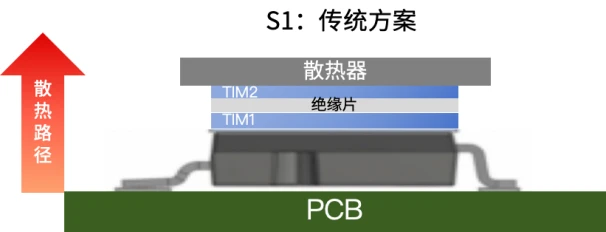
Traditional solution S1: Adding an insulating sheet between the MOSFET and the heat sink easily creates an air gap, which limits thermal conductivity and necessitates adding TIM material to improve heat dissipation.
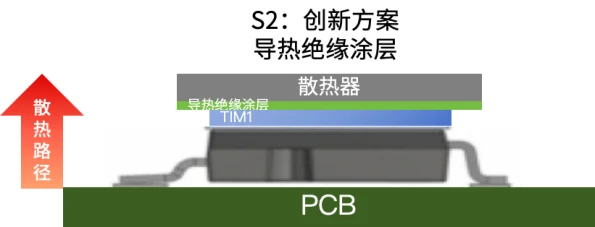
New Solution S2: Uses a precisely applied thermally conductive insulating coating that directly covers the back of the radiator/water channel, reducing air gaps and improving heat dissipation efficiency while ensuring insulation safety.
Thermal resistance test results:
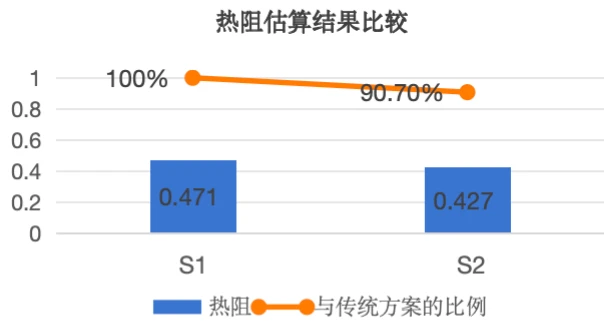
While meeting the 5000V DC breakdown voltage requirement, the innovative insulating coating solution S2 reduces thermal resistance by 9.3% compared to the traditional solution S1.
Thermal conductive insulating coating not only provides reliable thermal management and electrical isolation, but also helps customers achieve lightweighting, automation, and green manufacturing, making it a core material choice for next-generation electronic devices. It offers lower thermal resistance, higher reliability, and is well-suited to the trend toward miniaturization of power devices.


