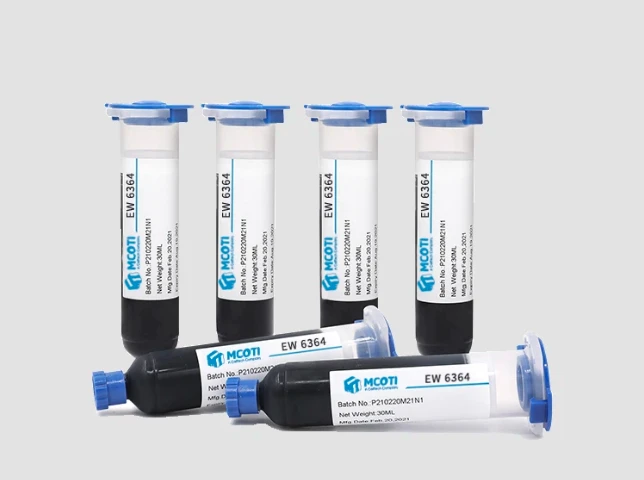
In the semiconductor packaging field, BGA technology has become mainstream due to its efficient pin layout. However, solder joints are susceptible to failure due to temperature fluctuations and vibration. As a "protective barrier," the performance of BGA underfill epoxy directly determines package reliability. Below, we analyze the core characteristics and selection process using two star MCOTI products.
A high-quality BGA underfill epoxy must meet four key characteristics.
First, low viscosity and high flowability. In BGA packaging, the gap between the PCB and the component is only a few hundred microns, and the material must seamlessly fill the gap through capillary action. MCOTI's EW6710, with a viscosity of only 750mPa.s, is suitable for high-density, narrow gaps; EW6364, with a viscosity of 3000mPa.s, offers strong flow stability and is suitable for applications requiring higher strength.
Second, high Tg and low CTE are key to resisting thermal stress. High Tg ensures the material does not soften at high temperatures, while low CTE reduces thermal expansion and contraction, maintaining consistency with thermal deformation of the PCB and components. Two of our products stand out: the EW6364 boasts a Tg of 150°C, and the EW6710 boasts a Tg of 143°C. Both have passed 1000 cycles of thermal cycling from -40°C to 85°C with no risk of failure.
Second, they offer strong bonding strength. Mechanical forces can easily cause solder joints to dislodge, and underfills require high shear strength to secure components. The EW6364 boasts a shear strength of 30MPa, while the EW6710 reaches 21MPa, far exceeding the industry's minimum requirement of ≥15MPa. They can withstand conditions like vehicle bumps and equipment vibration.
Finally, compliance and environmental resistance are crucial. High-end applications today place stringent demands on materials. Both products are RoHS and halogen-free certified, making them suitable for export. Furthermore, they have been tested for 1000 hours at 85°C and 85% RH, demonstrating stable electrical performance and bonding strength. They can be used in applications such as outdoor equipment and automotive cabins. BGA underfill is crucial to product lifespan. Its low-viscosity flow, high Tg, heat resistance, strong adhesion, impact resistance, and environmental resistance provide comprehensive protection for solder joints. Companies should avoid blindly pursuing "maximum parameters" when selecting a product, but rather prioritize core characteristics based on their specific application scenarios.
For applications in high-temperature, high-stress environments like automotive engine control units and industrial oven controllers, EW6364 is a top choice, with its high Tg of 150°C and 30MPa shear strength, enabling it to withstand extreme conditions. For applications in high-density, narrow-gap packaging, such as mobile phone processors and small sensors, EW6710's low viscosity and high flowability are more suitable, improving production efficiency.
As semiconductor packaging continues to shrink, become denser, and meet increasingly stringent requirements, BGA underfill performance will continue to improve. However, the principle of "matching characteristics to the application" remains unchanged-selecting the right material ensures that every solder joint withstands the test of time and the environment.